
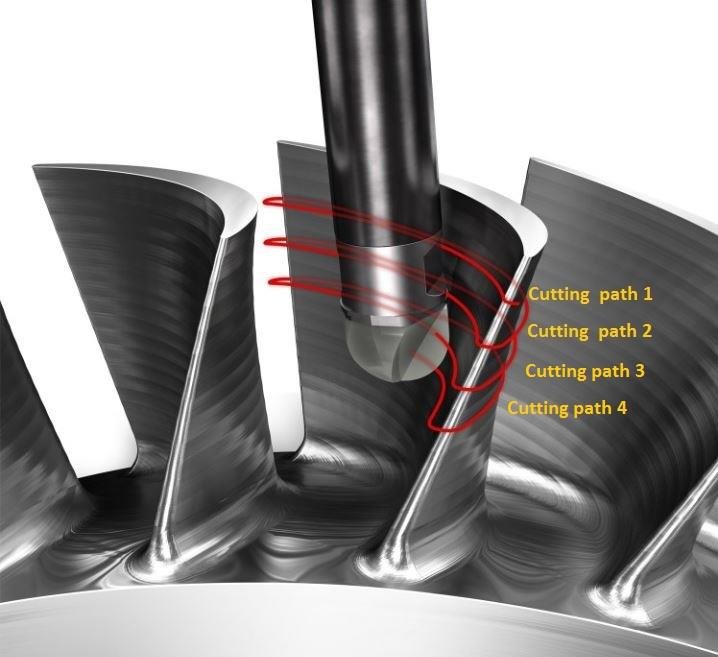
As turbine architectures push into new levels of thermal efficiency, load capacity, and rotational performance, the machining of thick-wall disk recesses has become one of the most demanding operations in modern aerospace manufacturing. These recesses—often found in compressor disks, turbine disks, and high-strength torque-transfer interfaces—require deep, stable metal removal across superalloys that are explicitly engineered to resist deformation, abrasion, and thermal fatigue. Traditional roughing or semi-finishing strategies that rely on uniform, fixed step-down increments often fall short when confronting the challenges posed by such dense materials and steep cavity geometries. Excessive cutting forces, unpredictable chatter, accelerated tool wear, and thermal accumulation can all compromise the accuracy and integrity of the recess. Ultra-stable CNC step-down strategies address these challenges by adapting depth-of-cut profiles, optimizing force distribution, and stabilizing tool engagement across the entire recess geometry. These advanced strategies offer unprecedented control over loading conditions, enabling manufacturers to machine thick-wall disk recesses with greater precision, consistency, and structural reliability—all while shortening cycle times and reducing overall machining costs.
Ultra-stable step-down machining is built on the principle of force-controlled depth management, a technique that allows each layer of material removal to be governed by predicted tool engagement and thermal behavior rather than static numeric increments. Traditional step-down methods apply uniform depths that do not account for variations in wall thickness, material hardness, or curvature transitions within the recess. This mismatch often results in unstable forces, leading to vibration, deflection, or even micro-cracking along thin sections of the disk. Conversely, adaptive step-down strategies integrate machine learning, tool engagement modeling, and real-time spindle load monitoring to fine-tune each transition layer. The machine automatically increases or decreases the step-down based on geometric intensity, balancing the cutting load across the entire toolpath. This predictable force control is particularly important when machining nickel-based superalloys—materials that generate significant heat and require precise engagement to avoid surface hardening. By harmonizing cutting pressure across each pass, ultra-stable step-down machining ensures uniform material removal, consistent thermal distribution, and dramatically enhanced surface quality within thick-wall recesses.
Multi-axis coordination plays a crucial role in unlocking the full potential of ultra-stable step-down strategies for turbine disk recess milling. Turbine disk designs frequently incorporate asymmetric recess shapes, tapered walls, and compound-angle surfaces that require simultaneous multi-axis adjustments to maintain stable tool orientation. Ultra-stable step-down processes integrate five-axis or six-axis interpolation to maintain optimal tool angle and contact geometry throughout deep cavity sections. This approach minimizes radial force spikes, keeps tool deflection under control, and reduces the risk of chatter that commonly occurs during deep cylindrical or conical recess machining. Axis smoothing algorithms, jerk-controlled transitions, and curvature-sensitive toolpath interpolation further contribute to stable force flow along the tool’s cutting edges. These advanced motion strategies preserve the structural integrity of both the tool and the workpiece, particularly in cavities where tight tolerances, thin walls, or rapid curvature transitions create high-risk machining zones. By blending step-down adaptivity with multi-axis intelligent motion, manufacturers achieve a level of stability and precision that traditional machining approaches cannot match.
Thermal stability is another defining advantage of ultra-stable step-down machining, especially when dealing with thick-wall turbine disks that trap significant heat during cutting. Deep recess milling requires prolonged tool contact time and sustained chip formation, both of which lead to increased thermal load on the material. If left unmanaged, this heat can cause microstructural changes, surface oxidation, expansion-induced dimensional drift, or even heat checking along the cavity surface. Ultra-stable step-down strategies reduce thermal accumulation by distributing cutting energy more evenly across progressive layers and adjusting cut depth based on predicted temperature rise. Integrated thermal simulation tools map expected heat zones before machining begins, guiding engineers to structure step sequences that alternate between cooler and hotter regions to prevent thermal buildup. During machining, thermal sensors and spindle load feedback further refine the process, allowing the machine to shorten step-downs when temperatures rise or extend them when conditions stabilize. This dynamic thermal control preserves the integrity of superalloy grain structures and ensures that the recess maintains long-term resistance to fatigue, creep, and thermal cycling—essential characteristics for components operating in high-stress turbine environments.
Another cornerstone of ultra-stable step-down machining is its synergy with digital twins, real-time simulation, and advanced predictive machining technologies. Before actual milling begins, engineers generate a digital model of the thick-wall recess and simulate a range of step-down patterns to evaluate their effects on tool engagement, chip expansion, coolant flow, and thermal distribution. These simulations highlight high-risk regions where excessive forces may develop, enabling the system to redesign step sequences that reduce stress concentration or tool pressure spikes. Once machining begins, real-time adaptive control systems monitor spindle torque, vibration signatures, cutting noise, and temperature gradients. Any deviation from anticipated conditions triggers automatic adjustments to feedrate, step-down depth, or tool engagement strategies. This real-time predict-and-correct cycle is vital for maintaining machining consistency, particularly in aerospace-grade superalloys where even minor deviations can result in dimensional inaccuracies or structural instabilities. Digital twins also provide historical data that enable continuous optimization; each machining cycle generates new insights that refine future step-down strategies, making the process progressively more reliable and efficient.
In the context of modern aerospace manufacturing, ultra-stable CNC step-down strategies have become indispensable for producing high-performance turbine disks that meet strict regulatory, aerodynamic, and mechanical requirements. These strategies significantly reduce tool wear, minimize machine downtime, and enhance repeatability across production runs. By ensuring stable forces, controlled temperatures, and uniform material removal, manufacturers can confidently achieve deeper recesses with tighter tolerances, smoother surfaces, and superior structural reliability. This capability is crucial as turbine engines evolve to operate at higher pressures, greater rotational speeds, and more extreme temperatures. Thick-wall disk designs will continue to grow in complexity, making traditional machining methods increasingly insufficient. Ultra-stable step-down machining provides a scalable solution that can be adapted to various geometries, materials, and performance criteria. It allows manufacturers to maintain a competitive edge by improving productivity, reducing operational risks, and delivering components that satisfy the highest standards of endurance and precision. As the aerospace sector continues to advance, the role of ultra-stable step-down strategies will only become more integral to successful turbine disk production, ensuring that next-generation engines perform reliably under the most demanding environmental and mechanical conditions.